

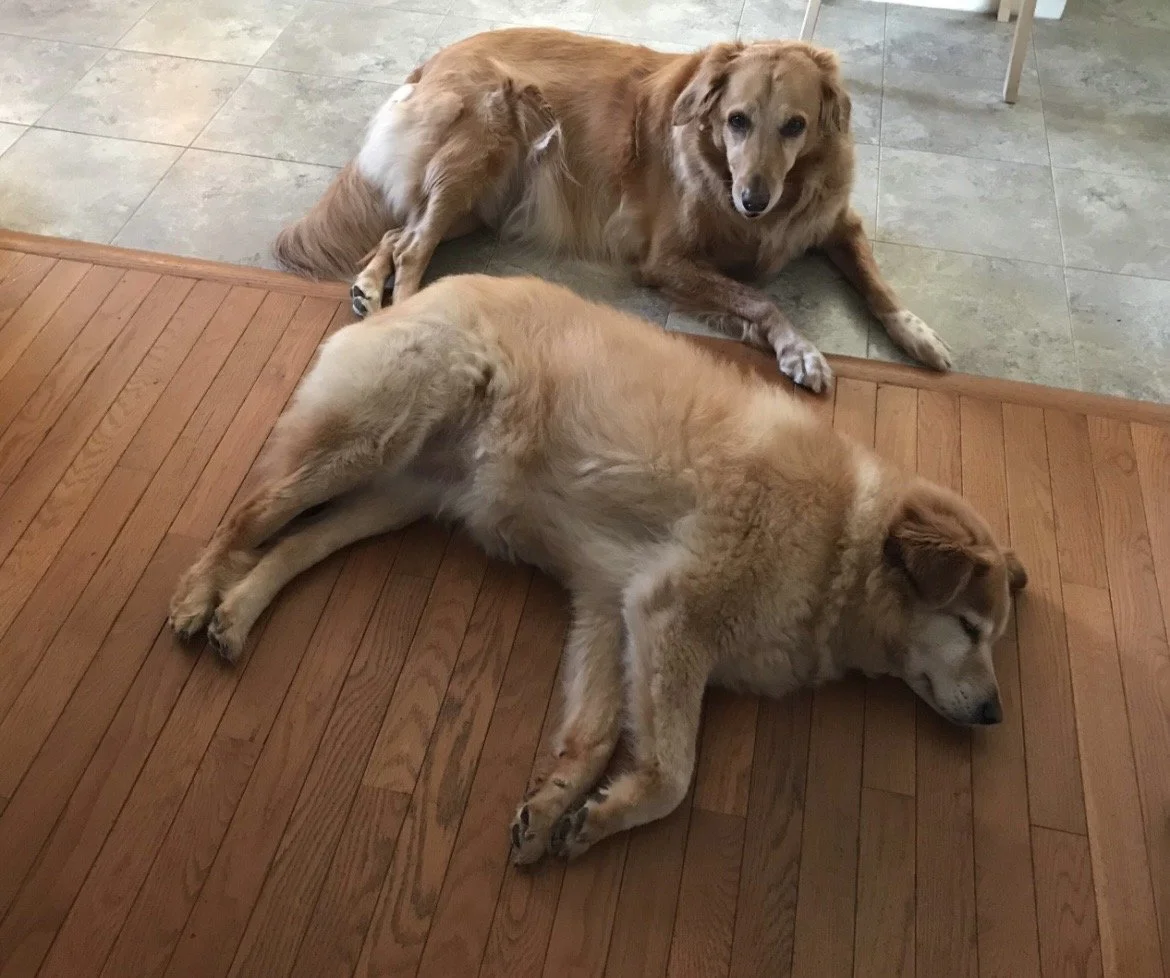
He’s a good dog.
He never leaves the yard. He comes when he’s called. He has never tried to climb the fence, dig underneath it, squeeze through the gate, or bolt out the front door.
And then somewhere nearby, a female dog goes into heat.
Suddenly, your very good boy may have a very different priority.
It isn’t romance. It isn’t disobedience. And it certainly isn’t a carefully considered decision about whether he is ready for fatherhood.
It’s biology.
And biology can be remarkably persuasive.
She Is Sending a Message He Was Built to Receive
When an unspayed female dog enters her heat cycle, her body begins broadcasting information about her reproductive status.
Her urine contains hormones and pheromones that communicate that information to other dogs. Male dogs can detect the scent of a female in heat from a great distance and may become intensely interested in finding her.
You may have heard claims that a male dog can smell a female in heat from several miles away. While dogs unquestionably have an extraordinary sense of smell, we could not find reliable veterinary research establishing one specific number of miles.
But we don't need an impressive number to understand the point:
She doesn't have to be standing on the other side of your fence for him to know she's out there.
A Fence Doesn't Turn Off Hormones
An intact male who detects a female in heat may become persistent about reaching her.
A dog who normally stays home can roam. A dog who has never cared about the gate may suddenly care very much about what is on the other side of it.
Sex hormones are associated with behaviors including roaming, mounting and urine marking. Veterinary research summarized by the Merck Veterinary Manual has found substantial reductions in roaming behavior in many male dogs following castration.
That tells us something important.
Sometimes what looks like a “behavior problem” isn't simply a training problem.
There is a powerful biological drive behind it.
And the female isn't necessarily a passive participant, either. During estrus, the receptive portion of her heat cycle, her own hormones and behavior are working toward reproduction.
Nature has had a very long time to get good at this.
They Only Need One Opportunity
This is where accidental litters happen.
“My dogs are never outside alone.”
“My yard is fenced.”
“He's never run away before.”
“We keep them separated.”
“She only got out for a few minutes.”
None of those statements necessarily comes from an irresponsible owner.
Accidents happen.
A gate doesn't latch. Someone opens a door. A dog slips a collar. A fence has a weak spot. Two dogs that are normally separated end up together.
And reproduction doesn't require repeated opportunities.
One successful mating can be enough.
Even the familiar “tie,” when dogs remain physically connected after mating, isn't required for pregnancy. A female can become pregnant without one.
And canine reproduction has another trick up its sleeve: sperm can remain viable within the female reproductive tract for days, meaning mating and fertilization do not necessarily have to happen at exactly the same moment as ovulation.
Her Heat Cycle Isn't Just One Obvious Day
Another problem with trying to prevent pregnancy through supervision alone is that canine fertility isn't always easy for an owner to pinpoint.
A female's heat cycle progresses through several stages. During proestrus, males may already be very interested in her even though she isn't yet receptive to mating.
Then comes estrus, when she becomes receptive and can become pregnant.
The timing varies considerably between individual dogs. Estrus averages around nine days but can last considerably longer or shorter.
And here's another surprise:
Dogs don't go through menopause the way humans do.
An intact female can continue cycling as she ages, although her fertility may decline.
So simply getting older doesn't automatically eliminate the possibility of pregnancy.
Dogs Don't Choose Their Mates Carefully
Here's something else nature doesn't ask a dog to consider:
“Is this actually a good idea?”
When hormones take over, dogs aren't evaluating whether another dog would make a good genetic match.
They don't consider whether the other dog is much larger or smaller. They don't know whether both dogs carry genes for the same inherited disorder. They don't evaluate health, structure or temperament. And they certainly don't stop to ask whether there are homes waiting for the puppies they might produce.
That means an accidental breeding can result in puppies with unpredictable size, appearance, temperament and health risks, particularly when the health and genetic backgrounds of the parents are unknown.
Some pairings may also increase the risk of inherited disorders if both parents carry genes associated with the same condition.
Responsible breeding involves deliberate decisions, appropriate health testing, knowledge of the dogs' genetic backgrounds and a plan for the puppies that may result.
Dogs don't make those decisions. People do.
And that's an important distinction.
Every puppy that is born deserves love, care and a safe home.
But that doesn't mean every breeding should happen.
Your Dog Isn't Thinking About the Puppies
An intact dog doesn't understand what happens after mating.
He doesn't know that a litter may result.
She doesn't know that pregnancy means puppies who will need food, vaccinations, veterinary care, socialization, safe homes and eventually spay or neuter surgeries of their own.
Neither dog knows that shelters and rescues are already trying to find homes for animals who exist today.
They are responding to biology.
We are the ones capable of understanding what comes next.
Prevention Is Once and Done
Here's one of the simplest things about spay/neuter that sometimes gets overlooked:
A traditional spay or neuter surgery is a one-time procedure.
It doesn't need to be repeated every year.
It doesn't need to be repeated every breeding season.
Once a dog has been surgically sterilized, owners don't have to spend every future heat cycle worrying about an accidental pregnancy.
One procedure provides permanent prevention of reproduction.
That's Why Prevention Matters
Spaying and neutering do something that fences, leashes and supervision cannot:
They remove the possibility of an accidental litter.
Traditional spaying also eliminates heat cycles and the reproductive hormones driving heat-related behavior. Neutering males removes the primary source of testosterone and can reduce breeding-related behaviors such as roaming and urine marking.
This doesn't mean every intact dog will escape.
It doesn't mean every male will travel in search of a female.
And it doesn't mean responsible management is pointless.
It means we're asking an animal to resist a biological system designed for one purpose:
Reproduce.
Sometimes the safest way to prevent an accident isn't to expect a dog to overcome instinct.
It's to remove the possibility of the accident altogether.
One Surgery. No Accidental Litter.
At PennyFix, we believe preventing unwanted litters is one of the most effective ways to reduce the number of dogs and cats who eventually need rescue.
That's why PennyFix raises money and awards funds to nonprofit organizations to pay in full for spay/neuter surgeries and vaccinations for dogs and cats.
Because when it comes to reproduction, dogs are remarkably good at doing exactly what nature designed them to do.
It's our job to make sure every litter is intentional.
One surgery. One time. A lifetime of prevention.
Spay. Neuter. Prevent the litter before it begins.
